

Culture Eats Strategy for Breakfast

We often hear the expression “culture eats strategy for breakfast” whenever a carefully conceived strategy doesn’t have any chance of success due to the limitations of the culture of the team or organization. An organization can develop a brilliant strategy… rigorous, ambitious, well-funded, and beautifully presented. But until team members make different decisions and take different actions, it remains an idea about the future… sadly without action or impact.
The phrase is frequently attributed to Peter Drucker, even though there is no evidence he ever actually said it. The idea endures because leaders recognize the truth behind it. In a recent conversation with an insurance executive, we were discussing their innovation strategy and how “corporate antibodies” rose up to kill the proposed change. He exclaimed, “That describes almost every company I’ve worked with over the last 20 years!” It’s a pattern we see over and over again… yet it doesn’t need to be that way!
Our most innovative ideas can be successful if we invest in our culture – intentionally developing and evolving it in alignment with our strategy. This necessary transformation allows teams to meet the challenges of new competitors and opportunities!
Culture Shapes How Work Gets Done
Culture is the collection of shared assumptions, daily habits, unwritten rules, traditions and beliefs that shape how work gets done. It influences which risks people take, which concerns they raise, which conversations they avoid, and what they do when no senior leader is watching.
While strategy describes where an organization intends to go, culture determines whether its people are prepared—and willing—to make the journey.
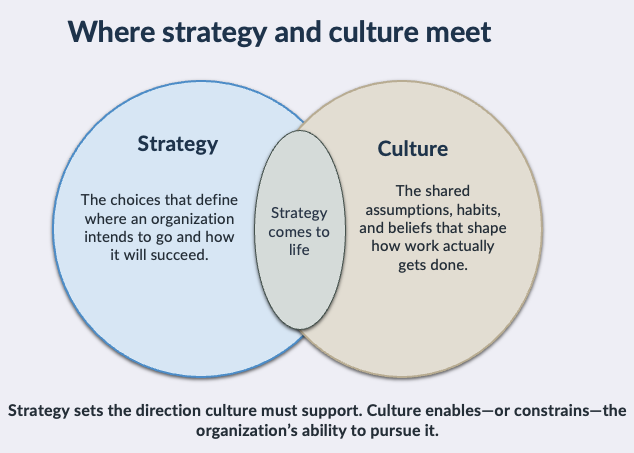
Across our work with leaders in insurance, banking, financial services, higher education and other mission-driven organizations, we have seen culture act as both a strategic asset and a strategic constraint.
A healthy culture can build trust and resilience, help an organization move faster and encourage people to take initiative. Yet the culture that contributed to an organization’s success may not be the culture it needs for its next chapter.
The same habits that produced yesterday’s success can restrict tomorrow’s possibilities. Prudence can become paralysis. Collaboration can become an excuse to avoid accountability. Loyalty to tradition can make necessary change feel like a rejection of the organization’s identity.
That does not mean leaders should discard the past. Culture change is rarely about replacing everything an organization has been. It requires understanding which qualities should be preserved, strengthened, or allowed to evolve.
This tension was part of the original inspiration for Bâton Global. For more than a decade, we have helped organizations preserve the strengths that made them successful while developing the judgment and adaptability needed to navigate change—in other words, to move from being risk-averse to risk-astute.
Artificial intelligence is one of the latest changes asking organizations to strike that balance. Sophisticated tools and thoughtful plans are important, but technology alone will not create transformation. Progress will depend on whether people understand and trust the tools, feel empowered to experiment and learn, and exercise sound judgment and accountability. The organizations that thrive will be those whose cultures support both curiosity and responsibility.
Closing the Gaps Between Strategy, Culture and Execution
Our recent research collaboration with Dr. Brian Wiersma explores these dynamics through what he calls the Organizational Gap Framework. The framework examines the relationships among strategy, culture and execution—and the gaps that can form between them.
A strategy may be clear but poorly translated into daily work. Execution systems may reward behaviors that contradict the organization’s stated values. A new strategic direction may conflict with deeply embedded assumptions about “who we are” and “how we succeed.”
These gaps can remain hidden until an initiative loses momentum, trust erodes, or performance suffers. What appears to be an execution problem may reflect a deeper misalignment between what the organization says it wants and what its culture makes possible.
We will share more about the framework in a forthcoming article. For now, the central lesson is simple: culture, strategy, and execution cannot be managed separately. Strategy provides direction. Culture supplies—or withholds—the human energy required to move. Execution connects the two.
Questions Worth Considering
Culture and strategy should not be treated as competitors at the breakfast table. The enduring value of the familiar phrase is not that culture will inevitably defeat strategy. It is that strategy can only become real through culture.
That invites leaders to consider:
- Is your culture strengthening your strategy—or quietly resisting it?
- Can your people explain their roles in bringing the strategy to life?
- Do your systems and leadership behaviors reinforce the values you claim to hold?
- Is your culture helping people approach change with curiosity and confidence—or with fear and resistance?
Culture is one of the most powerful and underleveraged assets available to leaders. Understanding it requires honest listening, disciplined diagnosis, and the courage to examine how decisions are truly made.
At Bâton Global, we help leaders identify the gaps beneath the surface and align their culture with the strategy ahead.
The question is not whether your organization has a culture.
The question is whether that culture is taking you where you need to go.
Sign UP to receive related Insights


Related Case STudies
View case studies

Trending Topics
View All


Schedule Your Session Today
Enter your information below and our team will contact you.