

The Death of MS Project (And What It Says About US)

Microsoft Project is not quite dead. But something important is dying.
The Decline of MS Project
Microsoft has been moving away from several of its traditional Project experiences, retiring Project for the web and consolidating much of that functionality into Planner. Project Online is also on its own retirement path. The desktop version still exists, and Planner Premium now includes many legitimate project-management capabilities: Gantt-style timelines, dependencies, milestones, critical path, workload views, goals, and more.
This is a signal about the state of management.
For years, Microsoft Project represented a certain idea of organizational life: work should be planned, sequenced, resourced, costed, forecasted, and managed against reality. That idea was never perfect. Project plans could become rigid. Gantt charts could create false certainty. Overbuilt PMOs could bury teams in ceremony. Plenty of leaders learned to perform project management rather than practice it.
But the best version of Project did something valuable: it made assumptions visible. It forced leaders and teams to answer questions that many modern work-management platforms make easy to avoid:
- What is supposed to happen first?
- What depends on what?
- Who is actually available to do the work?
- What happens to the schedule if one task slips?
- What happens to the margin if the work takes 20% longer than planned?
- When should we know we are in trouble?
That last question may be the most important.
The Rise of Visibility Without Accountability
A great deal of modern project management has become rearview-mirror management. We update cards. We move deadlines. We change the status from green to yellow, or from yellow to red, often after the consequence is already obvious. We report progress, but we do not always forecast outcomes. We track activity, but we do not always manage capacity. We celebrate collaboration, but we do not always create accountability.
These are leadership challenges.
The market has clearly rewarded tools that make work easier to see, discuss, and coordinate. Most organizations needed simpler, more collaborative tools. Many employees never needed a full project-management system; they needed clarity on their tasks, deadlines, owners, and team priorities.
And we lost something important in the migration from project management to task management.
A task list can tell you what people are doing, not if the organization is using its scarce capacity wisely.
A Kanban board can show work in motion, but not tell you if the economics make sense.
A dashboard can show status, but not whether a leader is willing to make a hard decision soon enough to matter.
That is the uncomfortable part. Forecasting is a cultutral as well as a technical capability
Many organizations avoid forecasting because forecasting creates accountability. It reveals tradeoffs. It exposes overcommitment. It shows when pet projects are consuming capacity. It makes it harder to pretend that everything is fine.
In that sense, the “death” of MS Project says something about us.
We have become more comfortable coordinating work than confronting work. We are often more willing to ask, “What is the status?” than “What is the forecast?” We like visibility, but not always consequences. We like flexibility and sometimes use it as a substitute for discipline.
Most change efforts do not fail because people forgot to create tasks. They fail because leaders under-resource the work, underestimate the human load, avoid difficult sequencing decisions, and do not build real management systems around the change. They communicate ambition, but they do not manage constraints. They launch initiatives, but they do not govern them. They ask people to absorb more change into an already overloaded operating system.
The healthiest organizations hold two ideas at once. This is something we refer to in our strategy work as ambidexterity; here’s an example:
Organizations need adaptability. Plans must change. Markets move. Clients shift. Talent constraints emerge. New information should alter decisions.
Organizations also need discipline. Adaptability without forecasting becomes drift. Collaboration without accountability becomes politeness. Agility without cost awareness becomes expensive improvisation.
This is where many organizations have overcorrected. They rightly moved away from command-and-control project bureaucracy. But in doing so, moved away from the underlying managerial muscles that made complex work possible: estimating, sequencing, resourcing, costing, forecasting, escalating, and learning.
Beyond Task Management
The future is not a return to large PMOs or rigid project plans that collapse on first contact with reality. The future is a better operating system for change.
That operating system should be lighter, more human, and more automated than the old world. It should reduce administrative friction. It should make it easy for people to capture time, progress, assumptions, risks, and changes without turning every professional into a project administrator. It should use AI and automation to surface insights rather than bury teams in reporting. It should connect proposals, scope, staffing, delivery, profitability, and learning.
The next generation of work management should not merely help us see more tasks. It should help us make better decisions. It should help us detect trouble earlier. It should help us understand whether our work is aligned with strategy, whether our people have the capacity to deliver, and whether our commitments still make economic sense.
The goal of project leadership was never to maintain a beautiful plan. It was and will always be to increase the organization’s capacity to deliver meaningful change.
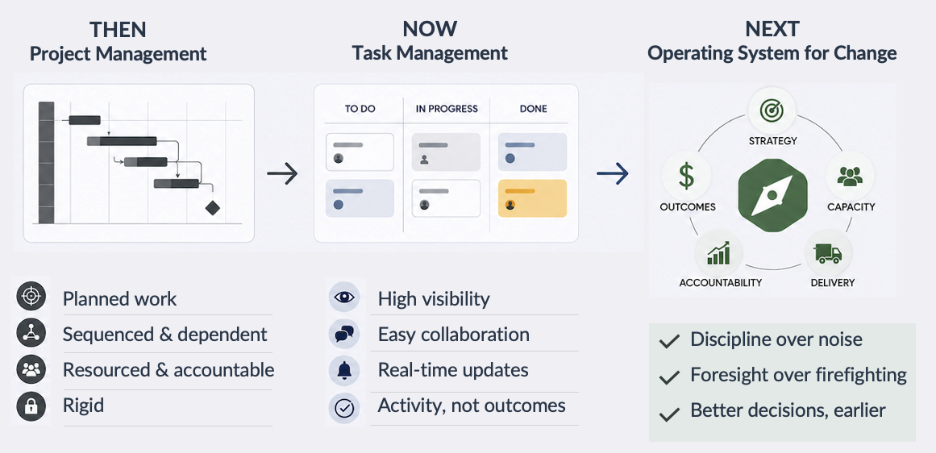
The slow fading of MS Project is worth noticing. Its decline marks a larger shift in how organizations think about work.
We have plenty of tools for collaboration. We have plenty of tools for visibility. We have far fewer habits of disciplined foresight that help us deliver judgment.
And that is where leadership work begins.
Bâton helps organizations build lighter, smarter operating systems for change; connecting strategy, capacity, delivery, economics, and accountability without drowning people in process.
Sign UP to receive related Insights


Related Case STudies
View case studies

Trending Topics
View All


Schedule Your Session Today
Enter your information below and our team will contact you.