

Individual Coaching in Leadership Development

Leadership development has traditionally relied on training programs, workshops, mentoring, and experiential assignments. Recently, we have witnessed a movement towards sustained, relational interventions to enhance long-established practices. Among these, individual coaching has emerged as one of the most consistently effective tools available to organizations seeking to grow their leaders. This article summarizes what the research says about the role of coaching in leadership development, the typical impact an employee experiences when coached, and the organizational impact when coaching is extended to an entire cohort rather than a single high-potential leader.
The Role of Individual Coaching in Leadership Development
Workplace coaching is best understood as a one-to-one, goal-focused, and collaborative relationship designed to help a coachee achieve outcomes that matter to their professional development (Jones et al., 2016). Unlike training, which transfers standardized content to a group, coaching is individualized: it adapts to the leader's specific context, blind spots, and developmental goals, and it relies on ongoing reflection and accountability rather than a single instructional event.
This individualization is precisely why coaching has become central to leadership development programs. Leadership growth is rarely only a matter of acquiring new information. It may require enhanced self-awareness, sustained behavioral change, and the ability to apply judgment in ambiguous situations. Coaching supports this kind of development by creating a structured space for a leader to reflect on their own thinking, receive candid feedback, and practice new behaviors between sessions with real accountability for follow-through. Executive coaching in particular has become one of the primary methods organizations use to develop leaders with significant managerial authority, precisely because it combines behavioral change with attention to the leader's personal aspirations and organizational performance (Grover & Furnham, 2016).
As Bâton Global coach Mia Ellis notes, “When you combine group learning with individual coaching, you help individuals integrate the classroom environment into their daily work and into their own developmental journey. You can learn about a concept in a class, like situational leadership, but then with a coach you examine how to bring it to life in your day-to-day world and consider how you might apply it.”
Impact of Coaching on the Individual Employee
The empirical evidence for coaching's effectiveness is now substantial. In one influential meta-analysis of workplace coaching studies, Theeboom et al. (2014) found statistically significant positive effects across five outcomes: performance and skills, well-being, coping, work attitudes, and goal-directed self-regulation, with effect sizes ranging from moderate to large. Goal-directed self-regulation showed the strongest gains, suggesting that coaching's core value lies in helping employees set clearer goals and sustain the motivation to reach them.
A separate meta-analysis focused specifically on learning and performance similarly found that coaching produced meaningful gains in skill-based outcomes, job satisfaction and self-efficacy, and individual goal attainment (Jones et al., 2016). More recent work using randomized controlled trials has also confirmed that coaching has a positive impact across leadership and personal outcomes (de Haan & Nilsson, 2023).
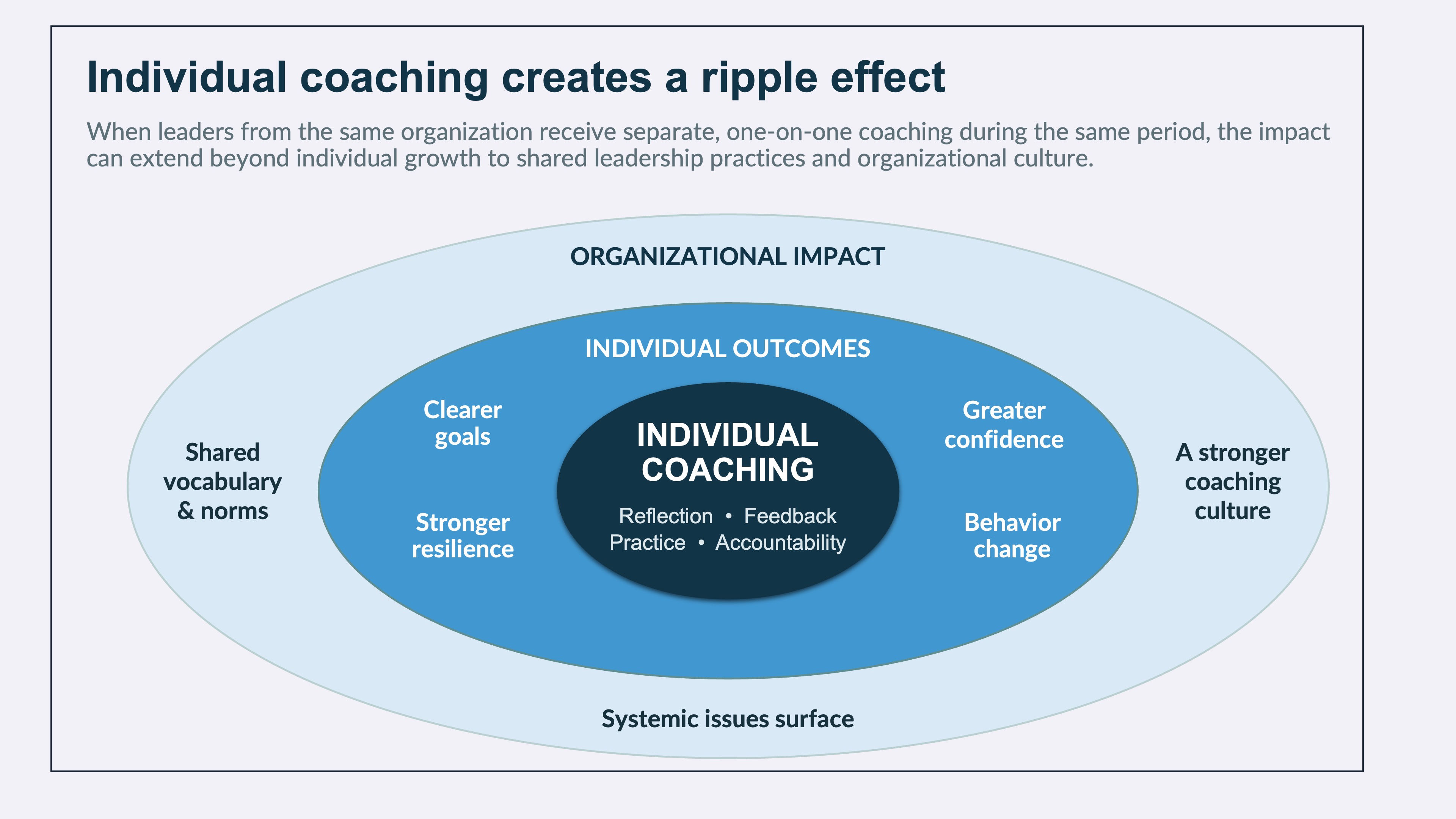
In practical terms, according to Nicolau and colleagues (2023), with coaching, an employee typically experiences several consistent shifts:
- Increased clarity as coaching conversations tend to surface goals and priorities that were previously vague or competing.
- Greater self-confidence and self-efficacy, particularly around decisions or conversations they had been avoiding.
- Improved coping and resilience, since coaching provides a structured outlet for working through setbacks rather than absorbing them silently.
- Measurable behavior change, e.g., more consistent follow-through, better delegation, or more effective communication, because coaching pairs insight with accountability in a way that a workshop alone cannot.
It is worth noting, of course, that outcomes are not universal; a minority of employees may experience limited or even negative results, typically when expectations between coach and coachee are mismatched, or the coachee is resistant.
Implications of Cohort Coaching for Organizational Development
The impact of coaching on an organization changes considerably when it is extended beyond a single individual to a cohort of employees moving through a program together. Several organizational-level implications follow.
First, cohort coaching tends to create a shared vocabulary and shared behavioral norms. When multiple leaders are working through similar frameworks around feedback, delegation, or difficult conversations at the same time, those behaviors start to reinforce each other across the organization rather than remaining isolated within one leader's team. This addresses a possible shortcoming of individual executive coaching, where new behaviors can be undermined by a surrounding culture that has not changed.
Second, cohort-based coaching accelerates the emergence of an overall coaching culture, in which leaders begin extending coaching-style behaviors such as curiosity, structured inquiry, and developmental feedback to their own direct reports. Manager-delivered coaching, once it takes hold, appears to substantially outperform coaching delivered only by external professionals as it scales across every conversation a manager has rather than being confined to scheduled sessions. Related research on psychological safety has found that teams led with consistent, inquiry-based behavior show measurably higher learning and innovation, an effect that accumulates through everyday interactions (Edmondson, 1999).
Third, coaching a cohort surfaces systemic issues that individual coaching cannot. When several coachees independently raise the same organizational obstacle, for example, an unclear decision-making process, leaders can treat this as organizational-development data rather than isolated complaints. This turns coaching into an informal diagnostic tool for the organization.
We would note that organizations should expect a lag between individual coaching gains and organizational change. Individual outcomes such as confidence and goal clarity tend to appear within a few months, but the deeper organizational cultural shifts take longer and depend on other factors such as incentives and behavioral reinforcement. Programs that pair a coaching cohort with manager training, so that coaching behaviors keep spreading afterwards, are more likely to sustain the gains than those that treat coaching as a self-contained event.
In closing, organizations should no longer view coaching as a remedial tool reserved for struggling executives or an exclusive benefit for a small number of senior leaders. The evidence increasingly positions coaching as a credible method for developing leadership behavior and as a strategic imperative that supports a variety of positive organizational outcomes. An intentionally selected cohort, working with coaches around both individual needs and shared organizational priorities, has the potential to influence relationships, norms, leadership practices, and ultimately culture.
References
de Haan, E.(2021). Critical moments in executive coaching: Understanding the coaching process through research and evidence-based theory. Routledge.
de Haan, E., & Nilsson, V. O. (2023). What can we know about the effectiveness of coaching? A meta-analysis based only on randomized controlled trials. Academy of Management Learning & Education, 22(4), 641–664.
Edmondson, A. C.(1999). Psychological safety and learning behavior in work teams. Administrative Science Quarterly, 44(2), 350–383.
Grover, S., & Furnham, A. (2016). Coaching as a developmental intervention in organisations: A systematic review of its effectiveness and the mechanisms underlying it. PLOS ONE, 11(7), e0159137.
Jones, R. J.,Woods, S. A., & Guillaume, Y. R. F. (2016). The effectiveness of workplace coaching: A meta-analysis of learning and performance outcomes from coaching. Journal of Occupational and Organizational Psychology, 89(2), 249–277.
Nicolau, A., Candel, O. S., Constantin, T., & Kleingeld, A. (2023). The effects of executive coaching on behaviors, attitudes, and personal characteristics: A meta-analysis of randomized controlled trial studies. Frontiers in Psychology, 14, 1089797.https://doi.org/10.3389/fpsyg.2023.1089797
Theeboom, T.,Beersma, B., & van Vianen, A. E. M. (2014). Does coaching work? A meta-analysis on the effects of coaching on individual-level outcomes in an organizational context. The Journal of Positive Psychology, 9(1), 1–18.
Sign UP to receive related Insights


Related Case STudies
View case studies

Trending Topics
View All


Schedule Your Session Today
Enter your information below and our team will contact you.