

Dynamic Capabilities in Practice: How Organizations Turn External Change into Strategic Response


Organizations are constantly responding to forces beyond their control—new technologies, shifting markets, regulatory changes, emerging risks, and evolving customer expectations. Most of these developments can be managed within an existing strategy. Others reshape the conditions under which an organization operates and require a different response. When the competitive environment changes in more fundamental ways, dynamic capabilities become especially important.
Dynamic Capabilities: From Awareness to Action
Dynamic capabilities describe an organization’s ability to adapt as its environment changes. They are commonly understood through three interconnected activities: sensing, seizing, and transforming.
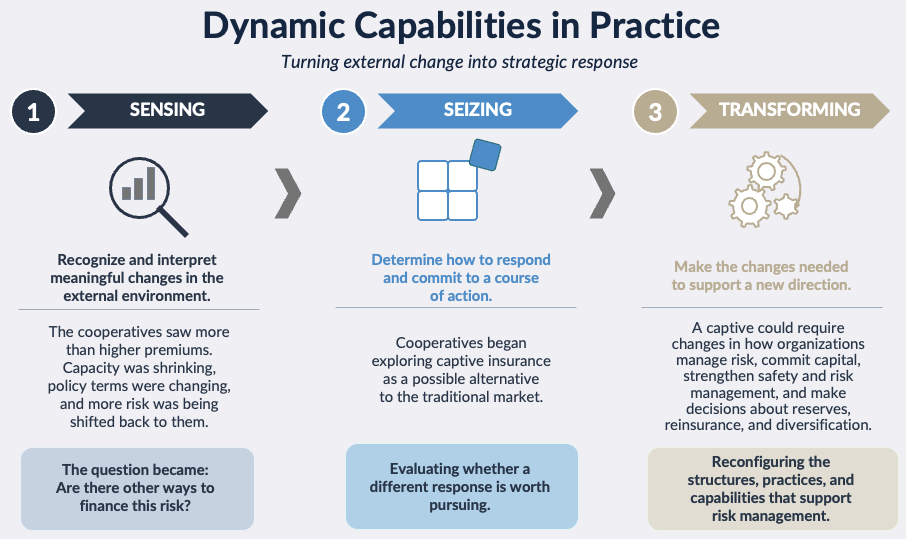
Sensing is recognizing and interpreting meaningful changes in the external environment. Seizing is determining how to respond and committing to a course of action. Transforming is making the changes needed to support that new direction.
What makes the concept useful is the progression. Organizations need more than awareness of change. They need to translate what they are seeing into decisions and, when necessary, adjust how they operate in order to carry those decisions forward. Working together, these activities help organizations renew the resources and capabilities on which future performance depends, rather than relying on what has worked in the past.
Bâton Global has explored dynamic capabilities in our previous article, Dynamic Capabilities: The Source of Competitive Advantage. Here, the focus is more practical: what do sensing, seizing, and transforming look like when an organization is responding to a real change in its environment?
A group of agricultural cooperatives facing a rapidly changing insurance market provides a useful example.
Sensing, Seizing, and the Path to Transformation
The cooperatives were facing significant challenges in obtaining affordable and comprehensive property and casualty insurance. A major carrier had exited the market. Remaining insurers were raising premiums and deductibles, adding exclusions, and in some cases offering coverage that was insufficient or unaffordable. Severe weather losses had also caused insurers to revise their expectations about future losses.
The first challenge was sensing what those developments meant. Higher premiums alone might have been treated as another difficult renewal. But price was only one signal. Capacity was shrinking, policy terms were changing, and more risk was being shifted back to policyholders. Together, those developments suggested that the traditional insurance market the cooperatives had relied on was changing in a more fundamental way.
Recognizing that shift changed the question from How do we secure the next policy? to Are there other ways to finance this risk? That moved the conversation toward seizing: evaluating whether a different response was worth pursuing. The cooperatives began exploring captive insurance, a form of self-insurance in which organizations create or participate in an insurance company established to cover their own risks. For organizations facing limited traditional coverage, a captive offers another way to approach risk financing.
Exploring a captive also raised the next question: what would need to change to make a different model workable? That is where transformation comes into view. A captive would shift more responsibility for risk back to the participating cooperatives, requiring greater discipline around capital, safety, loss prevention, reserves, and reinsurance. In practical terms, it would change not only how risk is financed, but how the cooperatives govern, monitor, and manage that risk over time.
Seen more broadly, the cooperative example illustrates how sensing, seizing, and transforming work together: organizations recognize meaningful developments, evaluate how to respond, and adapt the organization to support a new direction.
Keeping Strategy Aligned as Conditions Change
The value of dynamic capabilities is not in responding well to a single disruption. It is in developing an organization’s ability to repeatedly connect changes in its environment to decisions about where to act and what may need to change internally.
The cooperative example began with a problem in the insurance market, but the broader lesson extends well beyond risk financing. Changes in technology, regulation, customer expectations, competition, capital markets, or supply chains can all alter the choices available to an organization.
Not every change will require a transformation. New information may confirm that the current strategy remains appropriate, or an alternative may be explored and ultimately rejected. What matters is the ability to recognize meaningful shifts, evaluate their implications, and adapt resources, capabilities, and strategy when conditions warrant it.
That idea also reinforces an important principle of strategic planning: strategy cannot be separated from the environment in which it will be executed. At Bâton Global, our strategic planning work brings together an understanding of an organization’s capabilities with a clear view of the external environment to inform where it should focus and how it should move forward. Just as importantly, we view strategy as something to monitor and adapt as conditions change—not a plan that remains fixed once it is written.
Organizations cannot control how their environment will change. They can strengthen their ability to recognize meaningful shifts, make informed strategic choices, and adapt when those choices require something different of the organization.
Sign UP to receive related Insights


Related Case STudies
View case studiesTrending Topics
View All


Schedule Your Session Today
Enter your information below and our team will contact you.