

Courageous Leadership in an Age of Uncertainty

Organizations today are operating in an environment defined by disruption, ambiguity, and constant pressure to adapt. Markets shift overnight. Workforce expectations evolve rapidly. Technologies reshape industries faster than leaders can fully process them. In this climate, hesitation can be just as dangerous as poor decision-making. Yet uncertainty often causes leaders to retreat into caution, delay difficult conversations, or avoid bold action altogether. The leaders who succeed in today’s environment are not those who eliminate risk entirely, but those who develop the courage to act decisively despite incomplete information.
Courageous leadership has become a defining capability for organizations seeking to remain resilient, innovative, and competitive in times of uncertainty. Rather than avoiding uncertainty, courageous leaders confront it directly. They challenge outdated assumptions, embrace calculated risks, and create environments where adaptability and innovation can thrive. In doing so, they position their organizations to move forward confidently — even when the path ahead remains unclear.
Why Courage is the Defining Trait of Modern Leadership
Traditional leadership models built around hierarchy, predictability, and control are increasingly struggling to keep pace with modern business realities. Leaders are increasingly expected to navigate rapid technological change, shifting workforce expectations, geopolitical instability, and continuous market disruption — often simultaneously.
As a result, leadership now requires more than operational competence. It requires the courage to challenge outdated assumptions, make difficult decisions with imperfect information, and adapt quickly when circumstances change. Courageous leaders create momentum during uncertainty rather than paralysis. They foster cultures that encourage innovation, accountability, and resilience instead of fear-driven decision-making.
What Courageous Leadership Looks Like in Practice
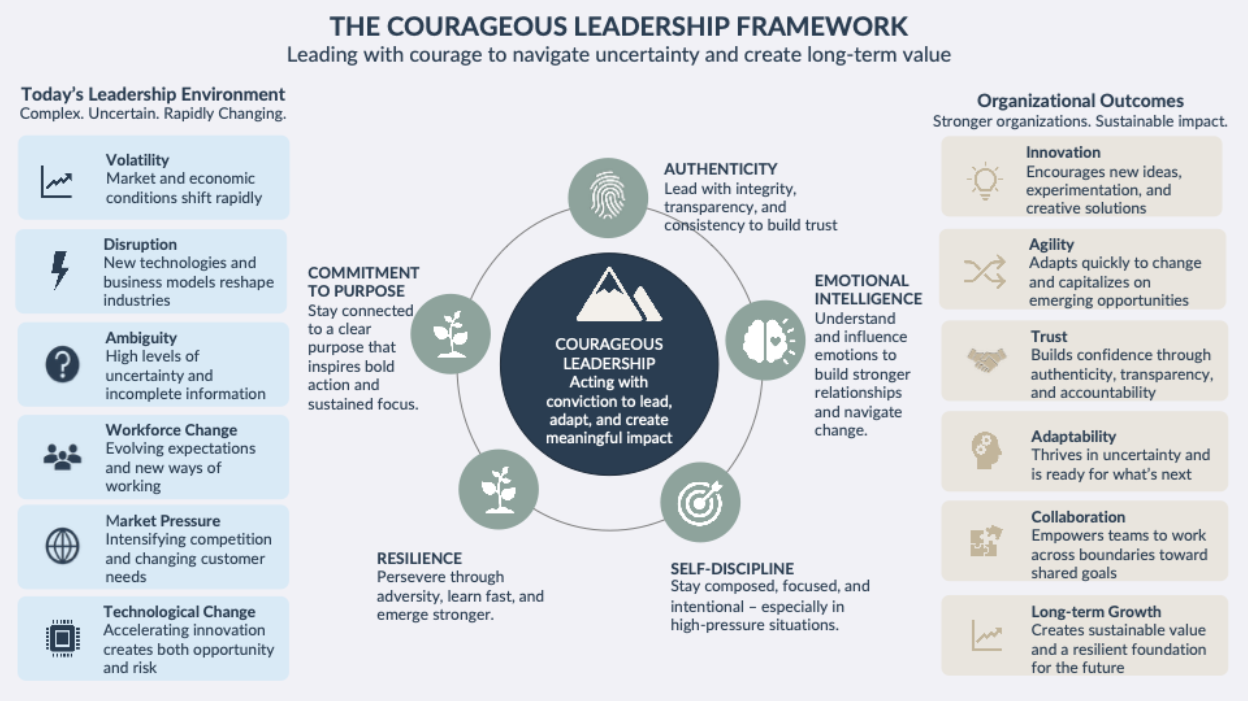
While courageous leadership can take many forms, several core characteristics consistently distinguish leaders who successfully navigate complexity and uncertainty.
Authenticity
Being authentic is essential to courageous leadership. It builds a foundation of trust, fosters an open and honest organizational culture, and allows leaders to make firm decisions during disruption. Authenticity creates transparency and consistency, resulting in stronger relationships with their teams. Additionally, research shows that genuineness in a leader drives higher employee engagement for an organization.
Resilience
Resiliency is important for courageous leaders because it lets leaders preserve through hard times, remain calm under pressure, and demonstrate adaptability. Moreover, resilience is not only the capacity to endure tough challenges but is also the ability to grow stronger in the middle of them. It is a trait that can be learned and honed overtime with experience.
Emotional Intelligence
A high degree of emotional intelligence is vital to being a leader who easily collaborates with others in achieving organizational goals. Studies show that emotionally intelligent leaders are superior at demonstrating a willingness and ability to change. Consequently, these leaders increase their trustworthiness and boost employee support for decisions related to change.
Self-Discipline
Courageous leaders must demonstrate self-disciple and composure to respond to the new demands of today’s business climate. In times of ambiguity, it is better to make decisions when one is poised and at their calmest, opposed to acting on initial, reactive instinct. Leaders should exercise self-control to remain consistent in uncomfortable situations. Also, a disciplined leader is able to make the tough, and sometimes unpopular decisions, that are not clouded by personal feelings or the desire for immediate approval.
Commitment to Purpose
A commitment to purpose provides the motivation and the ‘why’ behind a courageous leaders’ actions. It is the fuel needed to take bold risks in order to overcome difficult situations. When leaders are committed to a higher purpose than themselves, they are more willing to make tough choices and own the results of what transpires. Most importantly, it helps cancel out the noise of distractions and remain focused on what truly matters to the company.
How B|G Helps Organizations Lead with Courage
At Bâton Global, we help organizations develop the leadership capabilities, strategic clarity, and organizational alignment necessary to lead effectively through complexity and change. Through strategy development, leadership development, and organizational transformation initiatives, we help clients move beyond risk avoidance and build the confidence to lead decisively in uncertain environments.
Today’s business landscape demands leaders who can do more than maintain stability. Organizations need leaders who are willing to challenge outdated assumptions, navigate difficult conversations with transparency, make thoughtful decisions amid ambiguity, and adapt quickly as conditions evolve. Courageous leaders create cultures where employees feel empowered to contribute ideas, embrace innovation, and respond to change with resilience rather than fear.
Sign UP to receive related Insights


Related Case STudies
View case studies

Trending Topics
View All


Schedule Your Session Today
Enter your information below and our team will contact you.