A newly announced two-week ceasefire between the U.S. and Iran has driven a sharp rebound in global financial markets and a decline in oil prices, offering a sense of relief after weeks of volatility tied to disruptions in the Strait of Hormuz — a critical corridor through which roughly 20% of the world’s oil supply flows.
In a recent interview with KCCI Des Moines, Bâton Global CEO Matthew Mitchell, PhD, emphasized that the market response reflects a shift in expectations rather than a resolution of underlying risks.
I think the markets reacted based on expectations,” Mitchell said. “Where they were in panic, now they’re starting to settle into a wait-and-see mode, which is kind of where we’ve been the last few weeks.”
While the immediate market reaction has been positive, with stocks rising and oil prices falling, Mitchell emphasized that sustained economic impact will depend on whether conditions in the region stabilize over time.
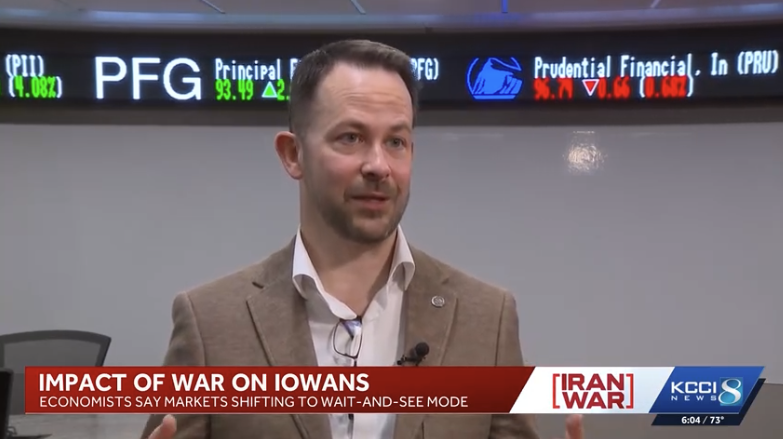
“That wait-and-see approach matters,” he noted. “One of the factors is the price of oil, but also the supply chain required to get that oil to refineries and ultimately to consumers. All of those have to be stable for quite a long time before we feel that relief.”
That distinction between short-term reaction and longer-term stability is critical. Energy markets respond quickly to geopolitical developments, but the transmission of those changes through supply chains, and into broader economic conditions, unfolds more gradually.
Beyond fuel costs, disruptions in the region carry broader implications. The Strait of Hormuz is a key transit point not only for crude oil, but also for natural gas and other commodities critical to global supply chains.
“Crude oil and gas prices get the headlines, but there’s a lot of other things that pass through the Strait of Hormuz,” Mitchell said. “Natural gas directly impacts the price of fertilizer that we feel here in Iowa.”
As a result, shifts in the region can extend beyond fuel prices, affecting input costs, food pricing, and operational planning across sectors. The extent of those impacts will depend less on immediate market movements and more on whether stability is sustained.
Mitchell also pointed to the implications for financial markets. While recent volatility has drawn attention to short-term fluctuations, long-term investment outcomes remain tied to broader economic conditions.
“For all of us who look at our retirement accounts, those are really long-term investments,” he said. “Markets react pretty quickly to news, but those longer-term investments really have to have stability over time. And right now, that stability isn’t there yet.”
Looking ahead, Mitchell noted that key indicators to watch include whether the ceasefire holds, ongoing diplomatic engagement, and conditions on the ground in the Middle East. These factors will ultimately determine whether recent market gains translate into lasting economic relief — and whether recent volatility proves temporary or more sustained.
Taken together, these developments point to a broader challenge for today’s leaders — making decisions in an environment where market reactions can shift quickly, while underlying conditions take far longer to stabilize. In the meantime, organizations must continue aligning near-term decisions with an outlook that remains uncertain and still evolving
Enter your information below and our team will contact you.